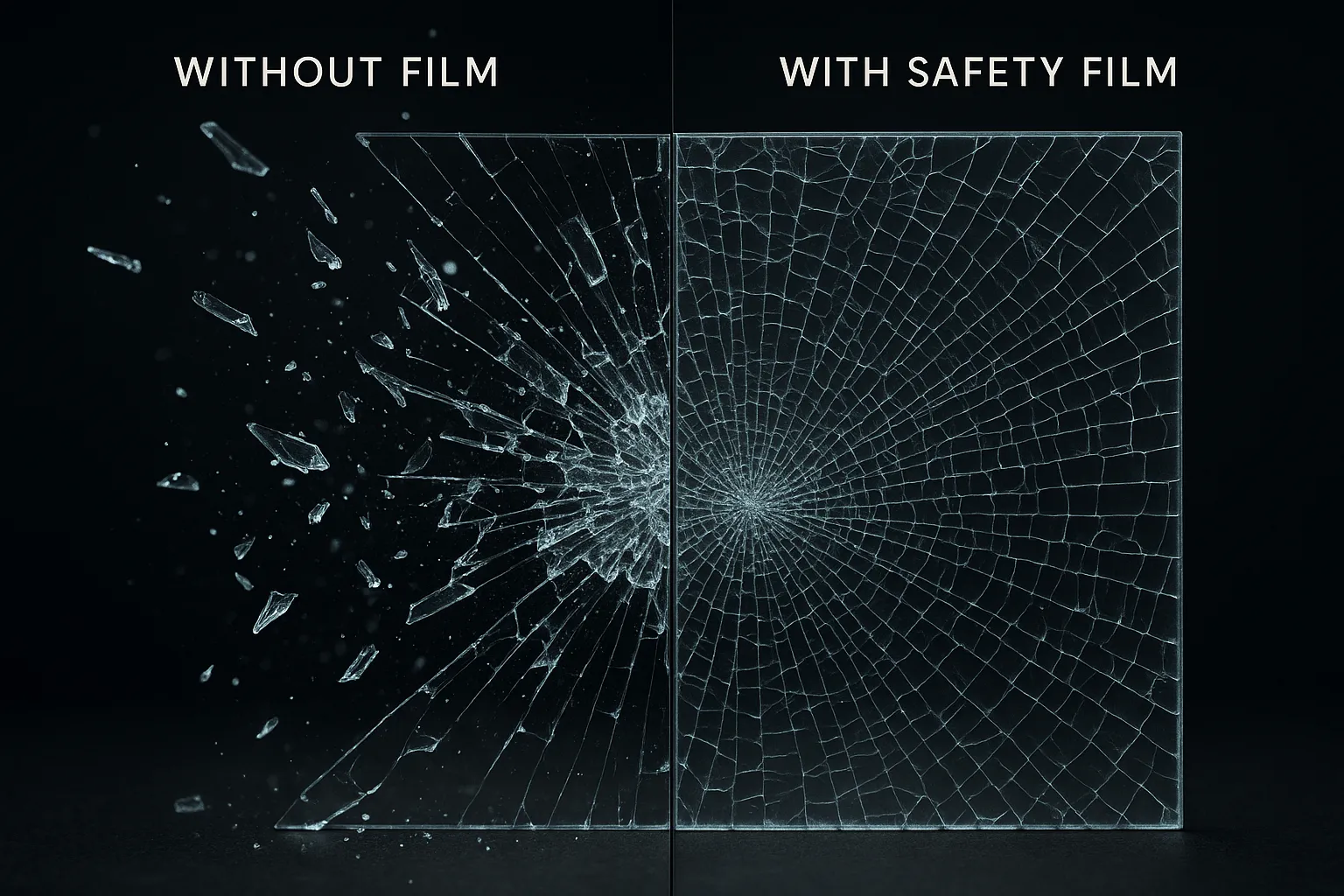
Anti-shatter film does not make glass harder to break. It changes what the glass does when it breaks. The film is a clear membrane bonded across the whole face of the pane, so when the glass fractures the pieces stay stuck to it rather than leaving the frame. Thickness is the main lever, which is why the range runs 4, 8 and 12 Mil. What it is not is bulletproof, blast-proof, or a heat film.
Most explanations of anti-shatter window filmstop at "it holds the glass together", which is true but tells you nothing useful about whether it fits your building. The mechanism is worth two minutes, because once you understand it you can judge a supplier’s claims yourself, and you can tell which questions actually matter at survey.
The problem is not that glass breaks
Glass is brittle. It does not bend and then recover; past a certain load it fractures, and it does so suddenly. That is a property of the material, and no surface treatment changes it.
The problem is what happens next. An untreated pane that fails releases its energy by coming apart, and the fragments leave the frame. In a villa with floor-to-ceiling glazing or a hotel atrium, that means loose glass travelling across an occupied space, plus an opening in the building envelope. Almost all of the harm sits in that second stage, not in the crack itself.
What the film actually does
Anti-shatter film is a transparent membrane bonded to the face of the glass with an adhesive layer. The important detail is that the bond is continuous across the entire pane, not fixed at the edges or at points.
So when the glass fractures, every fragment is still attached to the same sheet on every side. There is nowhere for a piece to go without taking the membrane with it. The pane cracks, but it tends to hold its shape in the frame, behaving much more like a cracked windscreen than a shattered window. The film takes on the load the glass can no longer carry.
That is the whole mechanism, and it explains the two things people find counter-intuitive: the glass still breaks, and the film still works.
Why thickness is the main lever
If the film’s job is to absorb and spread the energy of an impact, then how much film there is matters. That is why the range is offered in three tiers rather than one, and why "which mil" is the first question at survey.
| Tier | Where it fits | Price from |
|---|---|---|
| 4 Mil | The clarity tier. Closest to the glass’s natural shade, so it is the choice where appearance is the priority. Over 99% UV, 2-year warranty. | AED 116.67 / m² |
| 8 Mil | The all-round choice, with a scratch-resistant coat. The usual answer for typical residential and office glazing. | AED 141.07 / m² |
| 12 Mil | The thickest we supply. Maximum fragment retention, for large panes and higher-risk glass. | AED 147.20 / m² |
Rates are per square metre and pre-VAT; 5% VAT is added on top, minimum order 15 m², and installation is surveyed and quoted separately. Full detail on the pricing page.
Thicker is not automatically better. A heavier film on a small, low-risk pane is money spent on capacity you will not use, and the thinner tier is the more transparent one. Matching the tier to the pane is the point of the survey.
What decides the result in practice
Two identical films on two identical windows can behave differently. The variables that matter are worth knowing before anyone quotes you:
- The glass itself. Annealed, toughened and laminated panes fail in different ways and produce different fragments, so they respond differently to a retention film.
- Pane size and orientation. A large pane carries more stored energy and more weight of glass than a small one, which is part of what drives the thickness decision.
- How the film is finished at the edge. Film bonded only to the visible face of the glass retains the fragments, but the glazing itself is still held in the frame only by the original glazing method. What happens at that boundary is a legitimate question to put to any installer.
- Installation quality. Trapped contamination, lifted edges or a poor bond all reduce the continuity the mechanism depends on. This is a fitting-quality product as much as a material one.
What it is not
- Not bulletproof or blast-proof. We make no ballistic or blast claim for these films. Be sceptical of any supplier who does without independent test evidence to show you.
- Not a heat or privacy film. These are transparent films at roughly 89 to 90% visible light transmission. Cooling, glare and privacy are a separate product category. See does safety film block heat or UV?
- Not laminated glass. Laminated glass has its interlayer built in at manufacture; film is a retrofit to the glass you already own. See safety film vs laminated glass.
- Not a different product from "safety film". Anti-shatter film, safety film, safety glazing film and shatter-resistant film are the same category under different names, as we set out in this guide to the terminology.
Key takeaways
- The film does not stop glass breaking. It stops broken glass leaving the frame.
- It works because the bond is continuous across the pane, so every fragment stays attached.
- Thickness is the main lever, hence 4, 8 and 12 Mil, matched to the pane at survey.
- Glass type, pane size, edge finishing and installation quality all change the result.
- No ballistic, blast or injury-proof claim is made, and none should be accepted without evidence.
Want to know which tier your glass needs?
Tell us the pane sizes and the risk you are managing. We will recommend a thickness honestly, with a transparent per-square-metre estimate before anyone visits.
Our commitment
The honest version of this product is more useful than the heroic one. Anti-shatter film manages the consequences of breakage extremely well and does not pretend to prevent it, and a supplier who explains the mechanism is easier to hold to account than one who sells you an adjective. If a claim cannot be evidenced, we will tell you it cannot be evidenced.