Protect the game. Protect everyone around it.
An exterior-face glass retention system for padel courts: a clear, exterior-rated safety film combined with a compatible perimeter attachment that connects the filmed glass toward the court’s steel structure. It is designed to help keep shattered tempered-glass fragments together and reduce outward fallout, while leaving the playing surface untouched.
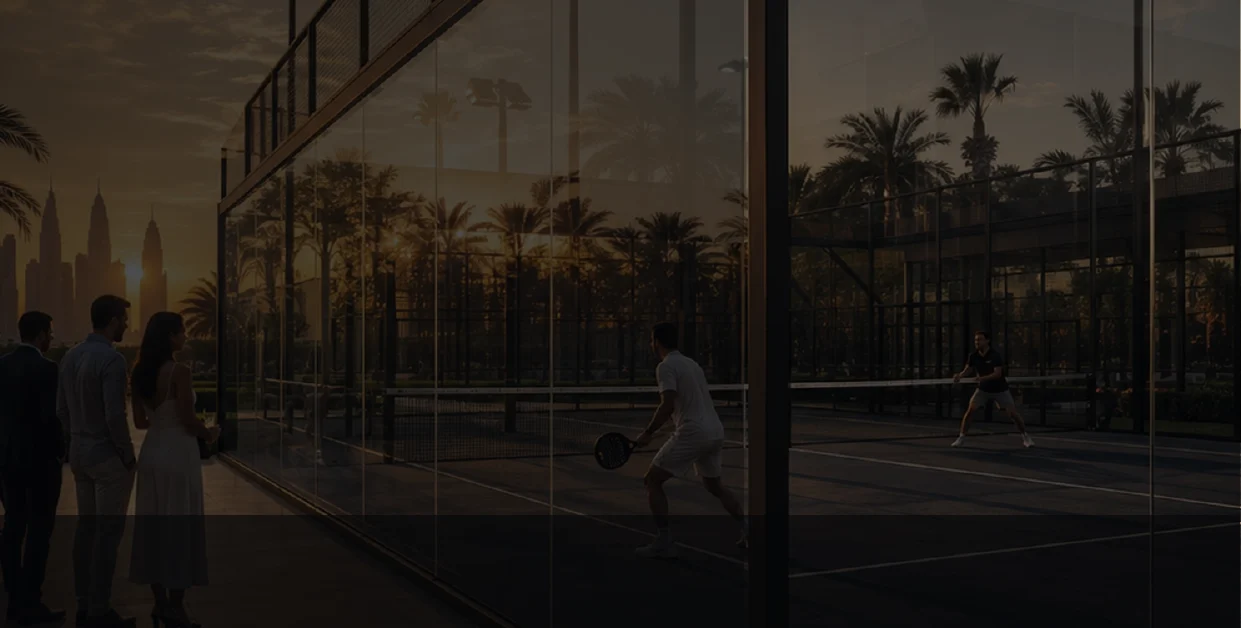
When court glass breaks, containment matters
Padel court glass is part of the playing environment. Tempered glass is designed to break into small pieces, which reduces sharp-shard risk, but it does not automatically keep a full court panel contained after failure. When a large panel fails, the issue is not only breakage: it is where the broken panel and its fragments go next.
Without a retention system
Fragments and the remaining broken sheet can move beyond the glass line, increasing risk to nearby walkways, spectators and adjacent activity.
With an anchored exterior system
The film helps retain the tempered fragments. The perimeter connection helps keep the filmed sheet linked to the steel structure, reducing uncontrolled outward fallout.
Why the outside face is the right place
Outside means the spectator-facing face, not the inner surface contacted by players and the ball. The orientation is simple: court, glass, film, public area.
- Playing face stays original. The inner rebound surface and its feel remain untouched.
- Less sport-related wear. The film is separated from regular racket, ball and shoe contact.
- Retention faces the public side. The membrane sits between the failed glass and nearby perimeter areas.
- Exterior-rated materials only. Film, adhesive and edge attachment are approved for heat, UV, moisture and cleaning exposure.
The correct system is more than film
The safest retrofit concept combines a clear exterior safety film with a compatible attachment detail that transfers the filmed glass membrane toward the court’s steel structure.
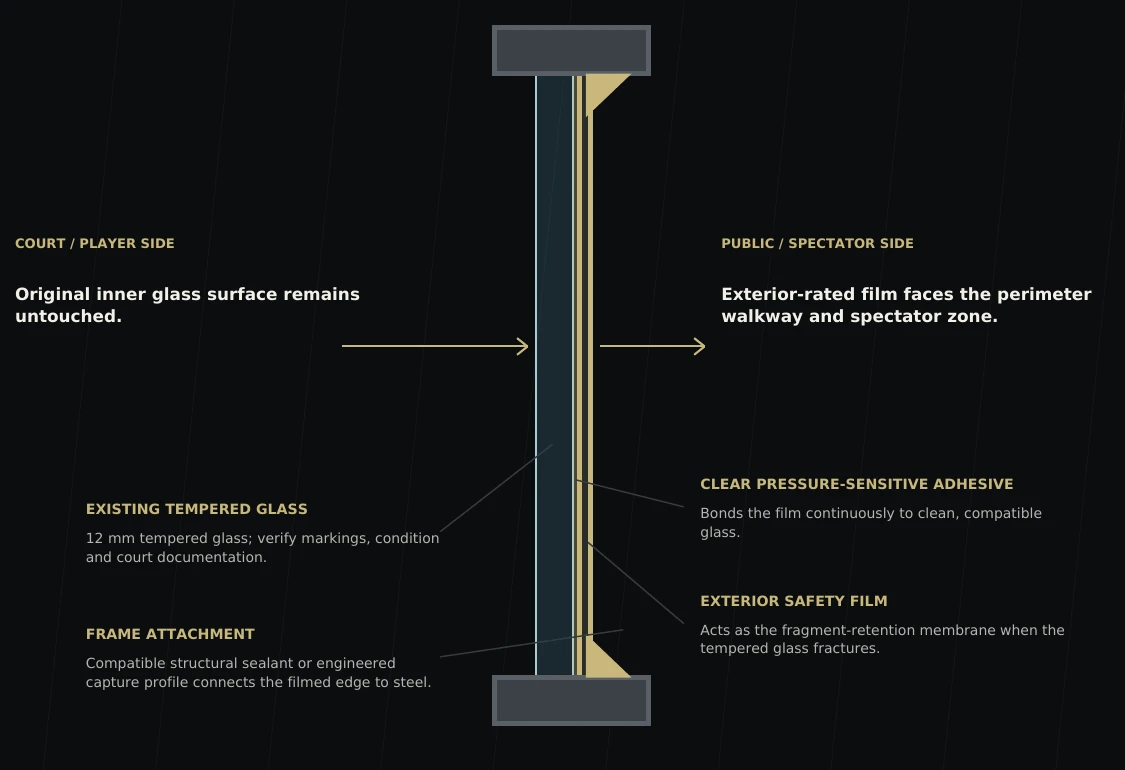
- Existing tempered glass. Typically 12 mm tempered glass; markings, condition and court documentation are verified first.
- Exterior safety film. Acts as the fragment-retention membrane when the tempered glass fractures.
- Clear pressure-sensitive adhesive. Bonds the film continuously to clean, compatible glass.
- Frame attachment. A compatible structural sealant or engineered capture profile connects the filmed edge toward the steel.
Why the edge connection matters
Film alone may hold fragments together, yet the broken panel can still leave the opening as one flexible sheet. A tested, compatible perimeter attachment is what helps connect that filmed sheet toward a suitable frame or engineered retention profile.
Concept cross-section, not to scale. Final materials and geometry must follow the selected system’s current technical instructions.
How the protection sequence works
The system is intended to change what happens after breakage, from uncontrolled fragment release toward a more retained, managed failure.
The simple explanation
We place a clear safety membrane on the outside of the court glass and connect its edges toward the steel structure. If the tempered glass breaks, the membrane helps hold the pieces together and the perimeter connection helps reduce the chance of the broken sheet falling toward nearby people or walkways.
The glass can still break. Protection depends on the selected film, attachment design, glass, frame, installation, maintenance and impact. No system makes a court injury-proof.
Two court types, one non-negotiable rule
The edge detail changes with the court. The need for a frame-connected retention path does not.
Framed perimeter
Use a compatible, manufacturer-approved structural attachment sealant or tested edge system along the available perimeter, bridging the exterior film toward the steel frame.
Exposed or point-fixed edges
Where edges are exposed or only point-fixed, use an engineered low-profile capture profile or an approved attachment detail fixed to the steel structure. Do not rely on film-to-film joints.
Rules that protect the court
- Never drill, grind, notch or field-modify tempered glass.
- Do not remove or loosen structural fasteners without the court supplier’s or engineer’s approved method.
- Keep original bolts, sleeves, gaskets and neoprene supports correctly seated and isolated from hard metal contact.
- Any new profile stays outside the playing envelope and must not create a snag, edge or impact hazard.
- Do not proceed on cracked, chipped, loose or misaligned glass; replace or repair the underlying condition first.
Installed from the outside, finished with precision
A controlled process protects the court, the installation team and the final finish.
- Close & isolateStop play, secure both sides and protect nearby users.
- Inspect & recordCheck edges, holes, fasteners, gaskets, alignment and existing damage.
- Confirm the systemVerify glass compatibility, exposure, access and the approved attachment path.
- Prepare the outer faceUse the system-approved cleaning and surface-preparation method.
- Apply the clear filmWet-apply, align and squeegee the full panel without bubbles or contamination.
- Detail edges & hardwareFinish around existing fixings exactly as the approved detail requires.
- Install the attachmentApply the compatible wet-glaze bead or fit the engineered capture profile.
- Cure, QA & hand overDocument the result and reopen only after installer sign-off.
Access equipment must be freestanding or structure-supported. Ladders, platforms or tools are never leaned directly against the glass. Site PPE, working-at-height and rescue requirements are followed throughout.
What we check before we recommend a system
A padel court is not a standard window. Every recommendation begins with the actual glass, fixing arrangement, steel structure, exposure and public-side risk.
- Court identityMake, model, supplier drawings and warranty conditions.
- GlassMarkings, type, thickness, panel size, edge and hole condition.
- FixingsBolts, sleeves, gaskets, neoprene, posts and frame continuity.
- ExposureHeat, UV, wind, moisture, irrigation, washing and chemicals.
- AccessWorking height, perimeter clearance, safe isolation and equipment.
- Public riskWalkways, seating, entrances, adjacent courts and children's areas.
- CompatibilityWritten exterior-use approval for film, adhesive and attachment.
- Structural pathWhere the retained membrane can transfer load toward the steel court.
Your project output
- Marked-up court elevation
- Film and attachment specification
- Access and isolation method
- Scope, quotation and exclusions
- QA and maintenance handover
Clear protection, original play
A discreet safety upgrade for the spaces immediately around the court, without adding a layer to the face used for play.
- Inner playing surface preserved
- Helps retain tempered fragments
- Helps reduce outward fallout
- Clear, discreet appearance
- Frame-connected system design
- Documented inspection & aftercare
Suitable for clubs, academies, hotels and resorts, schools, residential amenities, private courts and multi-court sports venues, subject to survey and system approval.