Judge a kit by the jobs it covers, not the item count. For UAE conditions there are six: breathable air, control of serious bleeding, a way out of a vehicle, protection from exposure, drinkable water, and light. A kit that covers all six in a case you will actually keep with you beats a bigger kit left in a cupboard. The VitraGuard Emergency Kit is eight items built around those six jobs, AED 995 plus 5% VAT, ordered by enquiry rather than online checkout.
Ask ten people what belongs in an emergency kit and you will get ten shopping lists. Shopping lists are how kits end up heavy, expensive and unopened. The more useful question is narrower: what situations could I plausibly be in here, and what would I need in the first few minutes?
That framing matters more in the UAE than in most places, because the plausible situations are specific. A lot of driving is long-distance motorway or off-road desert driving, where you may be some minutes from help and possibly the first person at a scene. Summers are severe, but desert nights are genuinely cold. And a great deal of life happens around water, in cars, and behind large panes of glass.
The six jobs a kit has to do
Every item worth its space answers one of these. Anything that answers none of them is weight you will not use.
| The job | Why it matters here |
|---|---|
| 1. Breathable air | Smoke, fumes or poor air quality in a vehicle, building or car-park incident. The one thing you cannot improvise. |
| 2. Stopping serious bleeding | The most time-critical injury there is. Minutes matter more than equipment quality. |
| 3. Getting out of a vehicle | A jammed door or a seatbelt that will not release. No other item in a kit solves this. |
| 4. Protection from exposure | Both directions: sun and rain by day, and genuinely cold desert nights. |
| 5. Drinkable water | Heat shortens the time you can wait. A means of treating found water buys hours. |
| 6. Light | Breakdowns, power cuts and roadside incidents after dark, plus being seen by whoever is coming. |
Where most kits go wrong
- They pad the item count. Thirty pieces sounds generous until you notice that twenty of them are plasters. Count jobs covered, not parts.
- They ignore the cold. Kits sold into hot climates often skip thermal cover entirely. A desert night after a breakdown is exactly when you want it.
- They are too big to carry. The best kit is the one in the car when something happens. A kit that only fits in a garage is a kit you will not have with you.
- They are never opened. Buying a kit is the easy half. Opening it once, so you know what is inside and where, is what makes it usable under pressure.
What is in the VitraGuard kit, and the job each item does
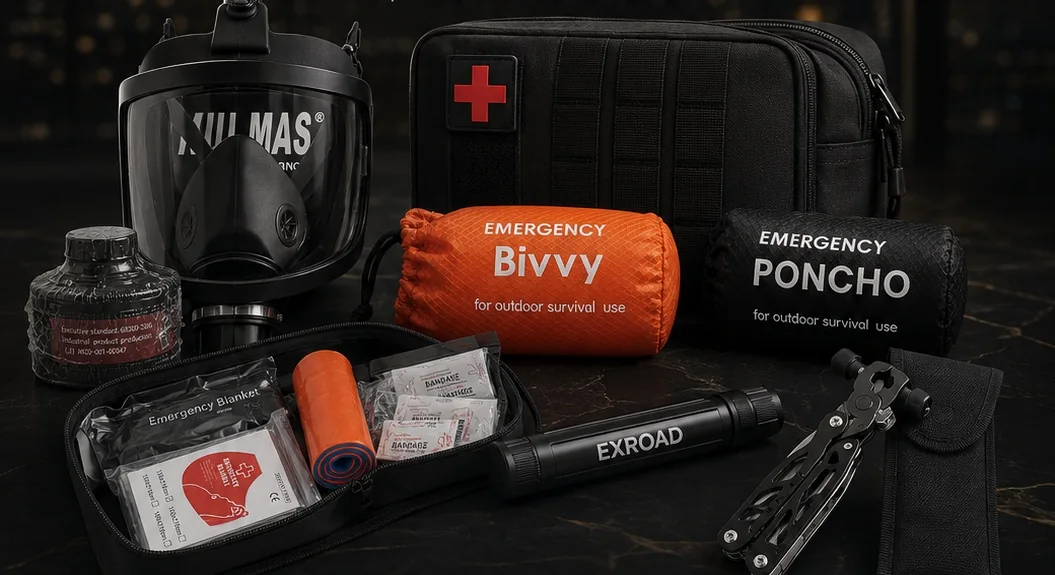
Eight items, chosen against the six jobs above rather than to hit a number. They ship together in one zipped carry case sized for a glovebox, a hall cupboard, or a yacht locker.
| Item | The job it answers |
|---|---|
| Full-face emergency gas mask | Breathable air. Intended to help protect against smoke, fumes and poor air quality. |
| Emergency trauma tourniquet | Bleeding. Designed to help manage severe limb bleeding until trained help arrives. |
| Vehicle rescue hammer | Escape. Helps break a side window and cut a seatbelt. |
| Emergency rain coat | Exposure, wet. Lightweight cover for rain or wet outdoor conditions. |
| Emergency sleeping bag | Exposure, overnight. Compact shelter for an unplanned night out. |
| Insulation blanket | Exposure, cold. Reflects body heat to help maintain warmth. |
| LED flashlight | Light. Compact and high-visibility for low-light incidents. |
| Water filtration straw | Water. Portable filtration to help treat water from natural sources. |
Every one of the six jobs is covered, and exposure is covered three ways because in this climate it is the job most likely to come up. Colourways and specification may vary between production batches.
Please read. An emergency kit is a preparedness pack for the minutes before trained help arrives. It is not a substitute for professional medical or emergency services, and no kit makes a situation safe. In the UAE, call 999 for police, 998 for ambulance and 997 for fire. Call first wherever you safely can, then use the kit.
Where to keep it
A kit's value is decided by where it lives, not by what it cost. The three placements that actually get used are the car (most incidents involving strangers happen on the road), the home hall cupboard by the door (so it leaves with you), and the boat locker if you are on the water regularly. Households running more than one car often keep a second kit rather than moving one between vehicles, which is also how most corporate fleet orders are specified.
What it costs, and how to order
The VitraGuard Emergency Kit is AED 995 per kit, plus 5% VAT. Delivery is free across the UAE and AED 200 to other GCC countries. Bulk and corporate pricing is available on request, including for fleets, and is handled through corporate and bulk orders.
The kit is ordered by enquiry rather than online checkout. That is deliberate. You confirm the quantity, the delivery address and the timing with a person before anything is charged, which matters more for a product bought once and kept for years than the convenience of a card form does.
Key takeaways
- Judge a kit by jobs covered, not item count: air, bleeding, vehicle escape, exposure, water, light.
- UAE conditions make vehicle escape and cold-night exposure more relevant than most kit lists assume.
- The VitraGuard kit is eight items covering all six jobs, in one case sized for a glovebox.
- AED 995 + 5% VAT, free UAE delivery, AED 200 GCC, bulk pricing on request.
- A kit supports the emergency services; it never replaces them. Call 999 / 998 / 997 first.
Want one, or a set for a fleet?
Message us and we will confirm quantity, delivery and timing before anything is charged. Corporate and fleet orders are quoted on request.
Our commitment
We will not tell you a kit makes you safe, because it does not. What it does is remove the excuse of having nothing to hand in the first few minutes, which is the window that tends to matter. We list what is in the kit, what each item is for, and what it costs, and we will say plainly when something is outside what we can stand behind. The same principle governs the rest of what we sell, including glass safety film: describe the job honestly, and let the product be judged on it.